
In high-volume injection molding, "standard" cycle times are no longer the benchmark—they are the limitation. While traditional straight-line cooling channels offer a baseline, TWI is pushing the boundaries of conformal cooling to unlock unprecedented levels of production efficiency.
By integrating our deep expertise in Metal Additive Manufacturing (AM), advanced mold tooling design, and forensic engineering, TWI develops conformal cooling solutions that do more than just reduce heat—they redefine the thermal limits of the injection molding process.
Engineering Out the Thermal Bottleneck
The primary objective of conformal cooling—whether integrated into a retrofit or a greenfield tool design—is to achieve uniform thermal distribution. At TWI, we use these advanced geometries to enhance cooling efficiency, directly resulting in reduced cycle times and increased Overall Equipment Effectiveness (OEE).
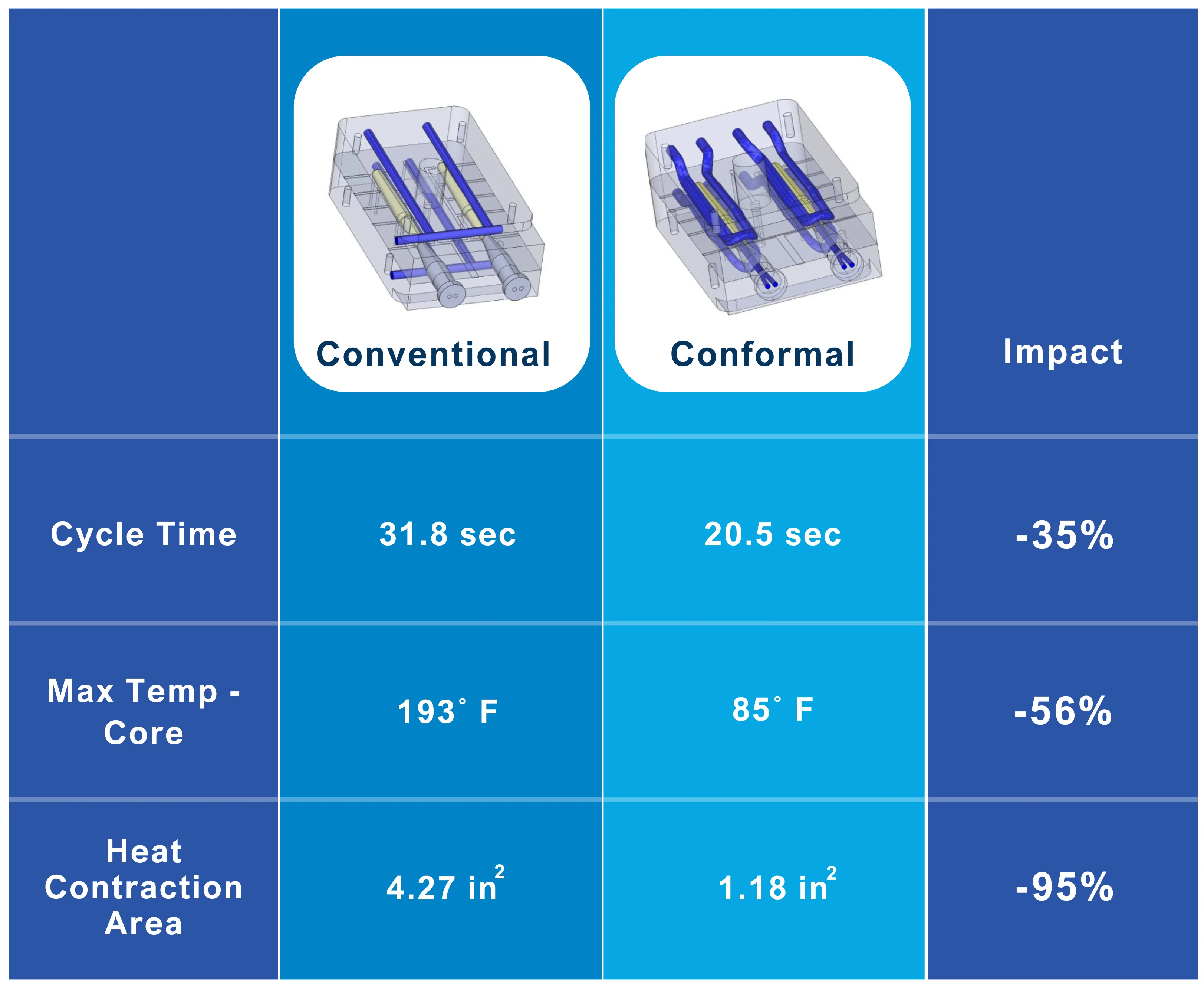
Case Study: Eliminating Simulated Hot Spots
In a recent mold redesign, Mold Flow Simulations identified critical "hot spots" at the part’s distal tips—areas where conventional cooling failed to penetrate.
TWI engineers developed a precision-engineered network of water channels that contoured exactly to the part's internal geometry. By focusing cooling on these high-heat zones, we stabilized the entire part’s thermal profile faster than ever before. This strategic cooling intervention significantly reduced mold-open time and eliminated the risk of thermal deformation.
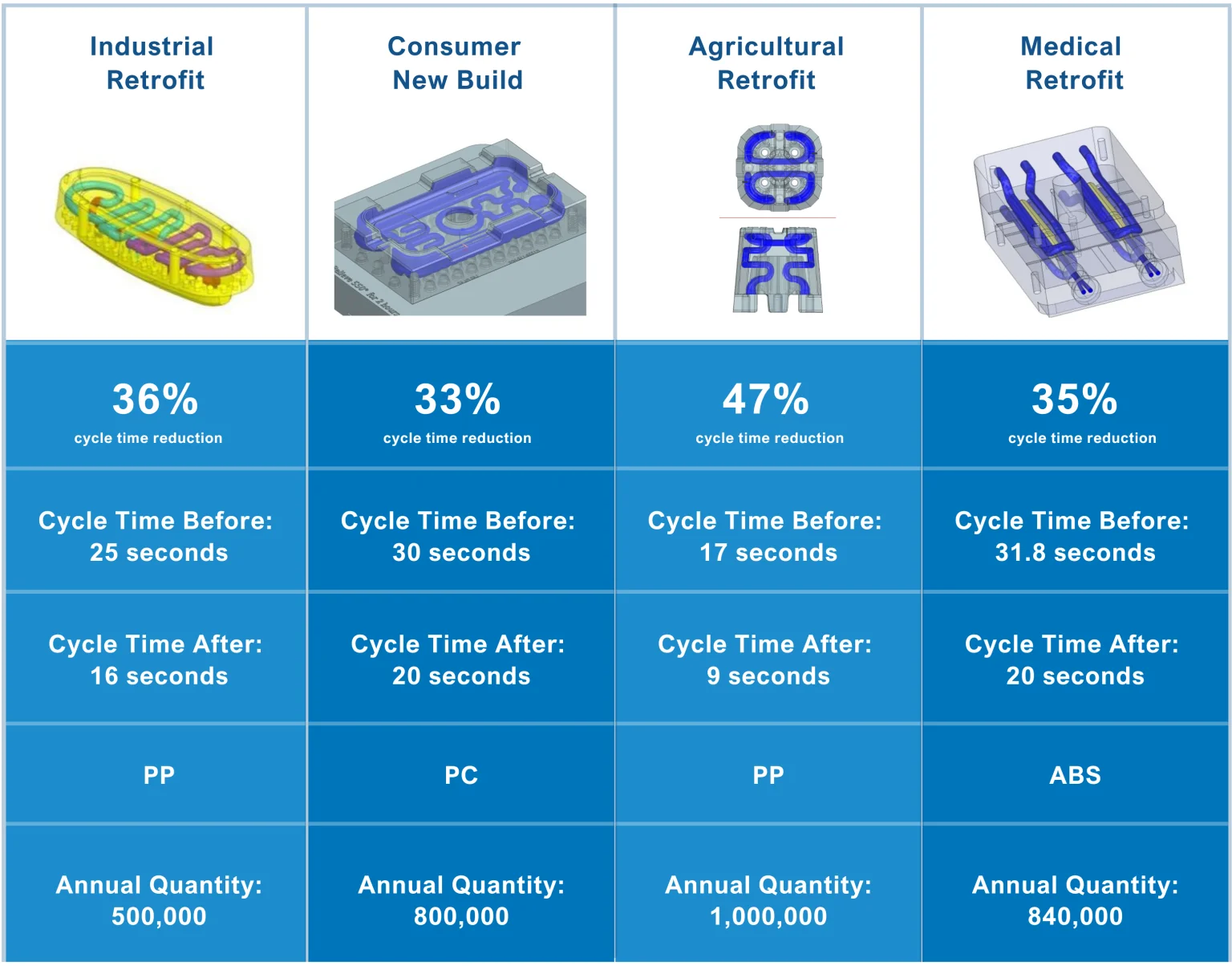
Why Design Experience Dictates ROI in Additive Manufacturing
Additive Manufacturing (AM), or 3D printing, is the primary enabler of conformal cooling. It allows for internal architectures and complex lattice structures that are physically impossible to create via subtractive machining (drilling).
However, the "complexity" allowed by AM requires rigorous validation to ensure mold longevity. The TWI advantage lies in our Integrated Design Phase:
Thermal Mapping: Moving beyond guesswork to identify precise heat flux.
Structural Integrity Validation: Ensuring that intricate internal channels can withstand high-pressure injection cycles without fatigue.
Digital Integration: Utilizing virtual testing to confirm cooling capacity before a single gram of metal is printed.
Technical Consultation: Optimize Your Cycle Times
As global leaders in materials joining and manufacturing technologies, TWI engineers understand the synergy between metallurgy and thermal dynamics. We don't just provide a tool; we provide a high-efficiency production solution.
Is your current tooling holding back your throughput?
[Contact the TWI Engineering Team] to explore how our conformal cooling and additive manufacturing expertise can transform your injection molding ROI.